
Toeing the Water
What a Jubilee Taught Me about Letting Go of Fear as a Writer

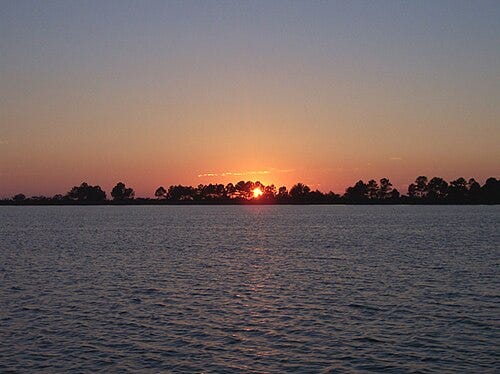
I grew up in Mobile, Alabama, where during the summers my family swam in Mobile Bay’s latte-colored water. The bay and its watershed, now sometimes referred to as “North America’s Amazon,” seemed as fraught with dangers as the actual Amazon. My toes sunk into the muck and silt of the bay’s bottom when I ventured ankle-deep into the water and my lungs filled with the stench of fish and fumes from the distant paper mill. I feared drop-offs I couldn’t see. I feared falling into a delta sludge turned quicksand or being dragged beneath the water by a scaly creature that lived in the deep. My younger cousin ignored me and ran headlong into the bay. She splashed and giggled, swam past the end of my uncle’s rickety wharf and floated face-up. I harbored enough fear for us both.
I wonder sometimes if I approached my early writing life with the same trepidation, waiting for the water to clear, the mud to turn sandy and white, for fairer conditions. But Mobile Bay rarely runs clear, and the mineral-rich mud is white-sand adverse. Occasionally, a surprise bubbles to the surface, though, and the bay boils over with fish. They flop, leaping and bunching toward shore, into what might be called a stampede if they were anything other than sea dwellers. Mobilians term this mosh pit of marine life a jubilee, a phenomenon related to oxygen disappearing from the bay except in the shallowest waters, causing fish and shellfish to crowd and swarm toward shore. Surface temperature, wind direction, and time of day play a role, too, but it’s anyone’s guess about a jubilee’s exact timing or where along the bay’s Eastern shoreline one will occur.
Most jubilees last mere minutes, and that summer, as I stood timidly on shore, I witnessed this miracle. Many Mobile residents live their entire lives without seeing a jubilee, but there I was, trying to avoid the water and scared of fish when shimmering scales of every kind surged toward shore. People from nearby bungalows ran with buckets and nets in hand toward flounder, mullet, red snapper and who knows what other bay-born creatures.
When I think about the jubilee moment in writing, it was when I began toeing the water of writers conferences and one allowed me to enter. It happened to be a women’s writing retreat. Everywhere I turned were fiction writers, memoirists and poets, and many spoke to and interacted with me—another miracle, I thought. I collected those moments, cherished them and inched toward calling myself a writer.
Not long after, I started graduate school in New Mexico—not that a graduate degree, a.k.a. MFA, is necessary for a writing life. For me, the decision was about giving myself space and time to create. Then, after completing my degree, I worked full-time jobs as a technical editor for 12 years, jobs seemingly unrelated to the fiction I wrote at 5 or 5:30 a.m. on weekdays and for hours each weekend. When I could afford it, I took classes, participated in workshops, went to conferences, and submitted my work. The steady interaction with other writers and readers kept me accountable, and more importantly, helped me build my writing community.
Sometimes I still overslept or didn’t write. Sometimes despair and self-doubt crept in despite my best efforts, but it’s not an exaggeration to say that community and accountability made the difference. It’s also not an exaggeration to say how much love and respect I feel for my fellow writers who kept me going. Sitting down to write often was—and is—the hard part. Some days it is the muddy bottom, the stink of fish, the murky water. Yet the work is discovery, and on the best days, is a jubilee.
Publication came to me over time. I published my first full-length short story in 2014, four years after completing my graduate program. Four years after that, I won a short-story contest. Another four years passed before my first book of fiction, It Falls Gently All Around and Other Stories, was released. Those years represent hundreds of rejections. Sometimes my piece wasn’t a fit, an issue was full, my submission didn’t appeal to those particular readers, or it needed more work. Whatever the reason, rejections helped me refocus and see that accepting myself and embracing the blue-brown water’s soft bottom has always been the true work ahead of me.
That childhood summer after witnessing a jubilee I ventured into the bay without coaxing and floated past the wharf with my cousin. The bay had become magical, a place where fish congregated and people sprinted from houses hauling wash tubs and nets on their backs. Writing took a similar path. Once I cleared away my excuses for not fully claiming my ground, I could fall backward into high tide and float. I could say for certain, I’m a writer.
The bay where I swam will hopefully thrive long past my time in its waters, though nothing is for certain given climate change and human folly. As for the locals who ran with their nets and buckets in hand, they taught me about community. The empty beach where I stood as a child had suddenly pulsed with people whose presence excited me and made me feel less alone. As writers, we often create in solitary spaces, but our writing lives, our lives in general, are made fresh and new in community.
Maybe the best thing I did during the years before my book was published was to stop comparing my success to other people’s idea of success. I wrote instead toward the woman I am and the one I want to be, toward the stories I want to tell. You might say I let go of the fear that held me back and found my own path into the bay. Not that I’m fearless or have it all figured out. It’s the work of a lifetime, or of several lifetimes, because the bay is large and looming.
—
A slightly different version of this post originally appeared on the Women Writers, Women’s Books website. Check out the site if you get a chance!
A quick note: There are only two spots left in my class focused on finishing your first manuscript. The first meeting is Oct. 1. You can learn more about the class here. It is my hope to build more community through this class and pay forward the many jubilees of my writing life.